How to use the liability limits calculator
Start with your own limits. Look at your declarations page, the summary page at the front of your policy. Liability limits are usually written as three numbers, such as 50/100/50, meaning $50,000 per injured person, $100,000 per accident for injuries and $50,000 for property damage.
Next, build a crash scenario. Enter injury costs for up to three people and the cost of damaged property. Use round, made-up numbers. Then change your limits to see how the gap shrinks.
A second worked example
What the result means
A result of $0 left for you means your limits would cover that scenario on paper. A positive amount means costs went past at least one limit. Look at which limit ran out:
| If the gap comes from | It means | Limit to look at |
|---|---|---|
| One person’s injuries | A single injury cost more than your per-person limit | Bodily injury per person |
| Several people’s injuries | All injuries together passed the accident cap | Bodily injury per accident |
| Property damage | The car or property cost more than your PD limit | Property damage |
| All three | Your limits are low for a serious crash | All limits, or an umbrella policy |
A gap does not mean you will automatically pay that amount. It means the injured people could seek it from you, and the outcome depends on the facts, your state’s laws and your finances.
State rules that change the answer
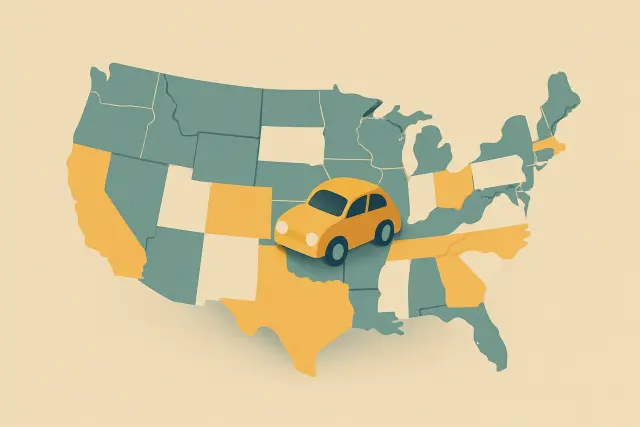
Each state sets its own minimum limits. For example, Texas requires at least 30/60/25 and California requires 30/60/15, according to the Texas Department of Insurance and the California DMV (accessed October 2026). Use our state minimum lookup to see yours.
In no-fault states, your own personal injury protection (PIP) pays your medical bills first, and lawsuits for pain and suffering are limited unless injuries pass a threshold. That changes how often injury claims reach your liability coverage, but it does not remove liability. Our no-fault vs at-fault states guide explains the differences.
Common mistakes
- Adding the three numbers together. 25/50/25 is not $100,000 of coverage. One injured person can get at most $25,000.
- Forgetting property damage limits are often low. A newer car or a crash with several vehicles can pass a $25,000 property limit quickly.
- Assuming the state minimum is enough. The minimum is a legal floor. Our state minimum car insurance guide shows how low some floors are.
- Mixing up whose costs count. Your own medical bills and your own car are covered by other parts of a policy, explained in our car insurance coverage types guide.
When should you think about higher limits?
If you own a home, have savings or have a steady income, a large gap puts more at risk. Ask your insurer for prices at a few higher limit levels. Raising limits often costs less than people expect, but only real quotes will tell you. An umbrella policy adds extra liability coverage on top of auto and home policies, and insurers usually require minimum underlying limits first.
How the calculation works in plain words
The tool follows the order a split-limit policy uses. First it looks at each injured person on their own and pays no more than your per-person limit for that person. Then it adds those amounts together and checks them against your per-accident limit; if the total is higher, the payment stops at that limit. Property damage is handled separately: the tool pays the repair or replacement cost up to your property damage limit.
The amount the policy pays is the injury payment plus the property payment. Everything else, the costs that went past one of your limits, is shown as the amount left for you. The tool does not guess how a court might divide the money among several injured people. In real claims, insurers and courts may settle with some people before others, and that can change who gets what.
How to pick realistic scenario numbers
You do not need real medical bills to use the tool. Try a few round scenarios instead:
- A minor crash: one person with a small injury and a dented car.
- A serious crash: one person with a major injury and a newer car that is totaled.
- A multi-car crash: two or three injured people and two damaged vehicles.
Run each scenario with your current limits, then with higher limits. If the amount left for you drops to $0 only at much higher limits, that is useful information to bring to your insurer when you ask for prices. The goal is to understand your exposure calmly, not to predict a crash.